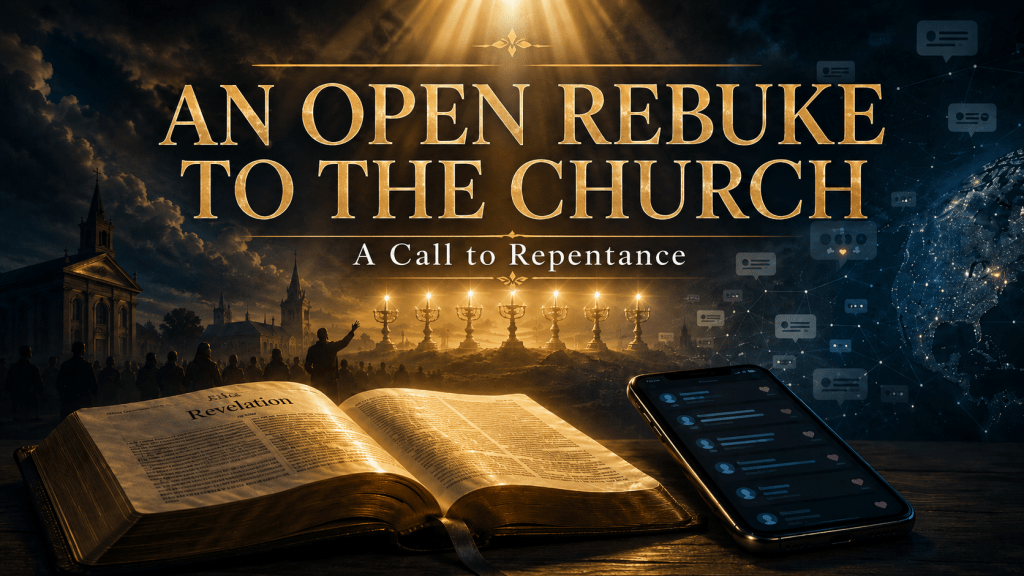
The Lord did not flatter the seven churches in Revelation. He examined them, praised what was righteous, exposed what was corrupt, commanded repentance, and warned them of the consequences of refusing correction.
This is not an attempt to invent a new revelation or place new words in Christ’s mouth. The words already written in Revelation 2–3 are sufficient. This is an application of those warnings to the modern Christian world—especially the version of Christianity displayed online.
Many believers have confused visibility with fruitfulness, popularity with authority, emotional excitement with the Holy Spirit, and religious language with holiness. Some speak constantly of truth while possessing little love. Others speak constantly of love while refusing to confront sin. Many defend personalities, ministries, political movements, and denominations more passionately than they defend the character of Christ.
The judgment must begin at the house of God.
“For the time is come that judgment must begin at the house of God.”
—1 Peter 4:17
And that examination must include the person writing the correction. No preacher, prophet, teacher, author, influencer, or believer stands above the Word. Before we rebuke another, we must be willing to stand beneath the same light ourselves.
To the Church That Has Lost Its First Love
Christ praised the church in Ephesus for its labor, endurance, and rejection of false apostles. Yet He said:
“Nevertheless I have somewhat against thee, because thou hast left thy first love.”
—Revelation 2:4
Many Christians online can identify false doctrine, expose corrupt leaders, debate theology, and dismantle another person’s argument—but they no longer resemble the Christ they claim to defend.
They are correct without compassion.
They speak of discernment while enjoying humiliation. They record another believer’s failure, repost it repeatedly, and call the spectacle “accountability.” They enter comment sections looking for someone to defeat rather than someone to restore.
Truth matters. Doctrine matters. Error must be confronted. But Christ did not say that possessing correct doctrine excuses the absence of love.
“Though I understand all mysteries, and all knowledge… and have not charity, I am nothing.”
—1 Corinthians 13:2
The correction is the same one Christ gave Ephesus:
Remember. Repent. Return.
Remember when you loved God more than you loved being recognized as right. Repent of using truth as a weapon for your own pride. Return to the works that flow from genuine devotion.
To the Church That Has Made Peace With Compromise
To Pergamum, Christ acknowledged faithfulness but rebuked those who tolerated teachings that led people into idolatry and sexual immorality.
“Repent; or else I will come unto thee quickly.”
—Revelation 2:16
Modern Christianity frequently renames compromise so that repentance no longer appears necessary.
Greed becomes “kingdom prosperity.”
Self-promotion becomes “building a platform.”
Cowardice becomes “keeping the peace.”
Lust becomes “human weakness.”
Celebrity worship becomes “honoring leadership.”
Political obsession becomes “standing for God.”
Some believers will condemn the sins of the world while excusing the same sins in their favorite preacher, musician, politician, or online personality. They do not ask whether conduct is righteous. They ask whether the person committing it belongs to their side.
God is not impressed by our side.
“God is no respecter of persons.”
—Acts 10:34
You cannot preach holiness to strangers while protecting corruption among friends. You cannot condemn deception in your enemies while sharing rumors that benefit your cause. You cannot call the world to repentance while treating repentance as unnecessary for your own tribe.
To the Church That Tolerates Jezebel
Christ told Thyatira:
“I have a few things against thee, because thou sufferest that woman Jezebel… to teach and to seduce my servants.”
—Revelation 2:20
The central issue was not merely that deception existed. It was that the church tolerated it.
The online church has developed an unhealthy fascination with spiritual titles, dramatic prophecies, secret revelations, and personalities who claim unquestionable authority. People announce dates, marriages, elections, judgments, financial breakthroughs, and private messages from God with little fear of misrepresenting Him.
When the prediction fails, the language changes. The prophecy becomes “symbolic.” The date becomes “a spiritual window.” The failure becomes the fault of those who lacked faith.
Scripture gives a far more serious standard.
“The prophet, which shall presume to speak a word in my name, which I have not commanded him to speak… even that prophet shall die.”
—Deuteronomy 18:20
Spiritual language does not make a statement true. Intensity does not prove anointing. Confidence does not equal authority. A large audience does not transform presumption into prophecy.
Test the spirits. Examine the fruit. Compare every message with Scripture.
“Believe not every spirit, but try the spirits whether they are of God.”
—1 John 4:1
And anyone who believes they have been called to speak for God should tremble more than they boast.
To the Church That Has a Reputation but Is Dead
To Sardis, Christ said:
“Thou hast a name that thou livest, and art dead.”
—Revelation 3:1
This may be the most accurate warning for the age of social media.
A ministry can appear alive because it has professional videos, emotional music, impressive graphics, thousands of followers, and constant engagement. A Christian can appear spiritually mature because their page contains verses, sermons, worship clips, and declarations.
But God does not judge a person by branding.
A platform may be active while the prayer life is dead. Content may be consistent while character is collapsing. A person may post publicly about forgiveness while refusing to forgive privately. They may teach submission while mistreating their spouse, preach generosity while exploiting others, or speak of purity while feeding secret sin.
“Having a form of godliness, but denying the power thereof.”
—2 Timothy 3:5
The command to Sardis was:
“Be watchful, and strengthen the things which remain.”
—Revelation 3:2
Wake up. Stop measuring spiritual life through attention, numbers, shares, invitations, and applause. Ask what remains when the camera is turned off.
To the Church That Is Lukewarm
Christ’s rebuke to Laodicea was severe:
“Because thou art lukewarm… I will spue thee out of my mouth.”
—Revelation 3:16
Laodicea believed it was rich and lacked nothing. Christ said it was spiritually poor, blind, and naked.
This is Christianity without surrender: enough Jesus to feel religious, but not enough obedience to disrupt comfort.
It reposts sermons but does not practice them.
It says, “God knows my heart,” whenever Scripture confronts its behavior.
It wants blessing without discipline, authority without submission, promises without commandments, resurrection without crucifixion, and a crown without a cross.
Many publicly declare, “Jesus is Lord,” while allowing anger, lust, money, popularity, entertainment, or politics to govern their decisions.
Christ does not merely ask to be included. He commands that He be Lord.
“Why call ye me, Lord, Lord, and do not the things which I say?”
—Luke 6:46
The correction is not despair. Christ said:
“As many as I love, I rebuke and chasten: be zealous therefore, and repent.”
—Revelation 3:19
His rebuke is evidence that He is still calling people back.
To the Christians Who Weaponize Their Tongues
The internet has made it possible to sin publicly, instantly, and before an enormous audience.
Christians share accusations without verifying them. They mock appearances, celebrate downfalls, repeat private information, and destroy reputations through insinuation. Then they place “praying for them” at the end of the post as though religious wording sanctifies slander.
Scripture says:
“Let no corrupt communication proceed out of your mouth.”
—Ephesians 4:29
And:
“The wrath of man worketh not the righteousness of God.”
—James 1:20
Not every angry post is boldness. Not every harsh statement is prophetic. Not every controversy deserves your participation.
Sometimes silence is wisdom.
Sometimes deleting the post is repentance.
Sometimes calling the person privately is obedience.
Sometimes the most spiritual action is admitting, “I spoke before I understood.”
“He that answereth a matter before he heareth it, it is folly and shame unto him.”
—Proverbs 18:13
Correction Must Also Be Correct
The answer to foolish Christianity is not fleshly rage disguised as righteous indignation.
Scripture commands correction, but it also commands how correction should be given:
“The servant of the Lord must not strive; but be gentle unto all men… in meekness instructing those that oppose themselves.”
—2 Timothy 2:24–25
Meekness is not cowardice. Love is not tolerance of sin. Gentleness is not compromise. But correction that flows from pride will eventually reproduce the very corruption it condemns.
The goal is not to prove that people are fools. The goal is that foolish people become wise.
The goal is not destruction, humiliation, or personal victory. The goal is repentance, restoration, holiness, and reconciliation with God.
“Brethren, if a man be overtaken in a fault, ye which are spiritual, restore such an one in the spirit of meekness.”
—Galatians 6:1
Notice the word: restore.
Let Him Who Has an Ear Hear
Christ ended His messages with a repeated command:
“He that hath an ear, let him hear what the Spirit saith unto the churches.”
—Revelation 2:7
Not merely what the Spirit says to our enemies.
Not merely what He says to compromised denominations, false teachers, internet personalities, or believers we dislike.
What is the Spirit saying to us?
Have we abandoned our first love?
Have we tolerated compromise?
Have we followed personalities more than Christ?
Have we confused online activity with spiritual life?
Have we spoken recklessly?
Have we become lukewarm while calling ourselves blessed?
Let every believer—including every person who corrects others—come before Christ honestly.
The churches in Revelation were not told to defend their image. They were told to repent.
The same Lord still searches hearts. He still exposes hidden motives. He still disciplines those He loves. And He still promises life, authority, fellowship, and victory to those who hear His voice and overcome.
Church, wake up.
Return to your first love.
Reject compromise.
Test every spirit.
Strengthen what remains.
Be zealous and repent.
And before speaking another word in the name of Christ, make certain that your conduct bears His likeness.