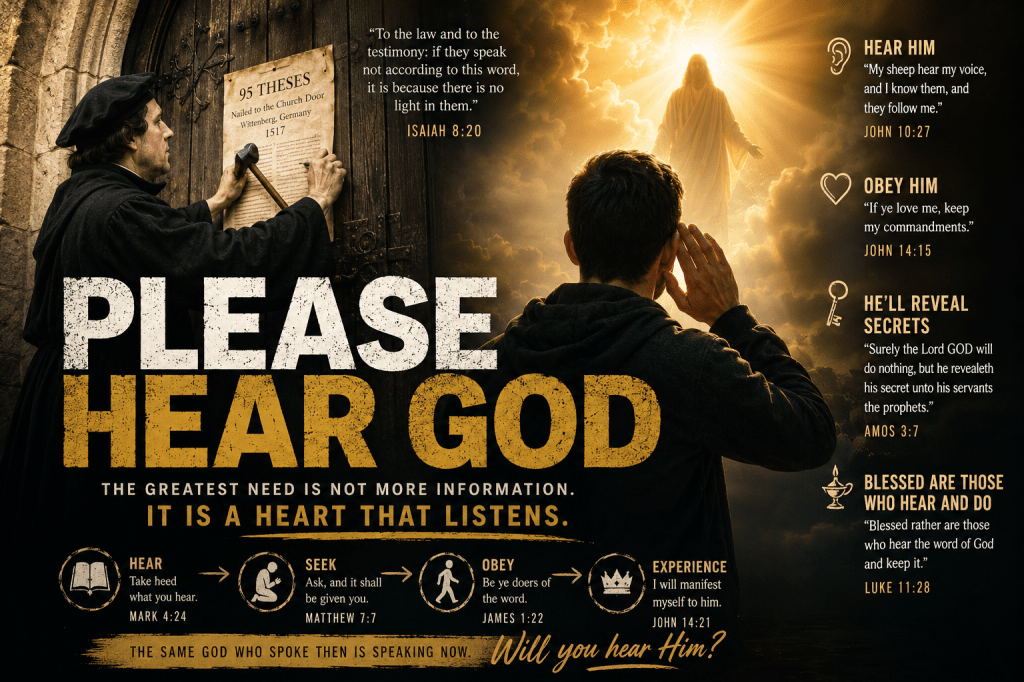
In 1517, a monk named Martin Luther nailed ninety-five theses to the door of the Castle Church in Wittenberg, Germany. He was not trying to start a movement. He was trying to correct a distortion — the idea that a relationship with God could be purchased, mediated, outsourced to a system, managed by an institution instead of walked out directly with the Living God. Luther’s protest cracked open a question the Church had buried under centuries of tradition: can an ordinary person actually hear from God themselves, or do they need someone else to hear for them?
Five hundred years later, the paper has changed. The door has changed. But the question has not moved an inch.
Please hear God.
Not hear about Him. Not hear a sermon about Him, a podcast about Him, a book about Him — hear Him. Directly. Personally. Today.
The Thesis Luther Nailed, and the Thesis We’re Still Avoiding
Luther’s core argument was that salvation and relationship with God are not brokered goods — they are received by faith, directly, by anyone who will come to Him (Ephesians 2:8-9). He was attacking a system that had inserted itself between the believer and the voice of God.
But here is the uncomfortable follow-up question the Reformation opened and never fully closed: if we don’t need a priest to access God’s grace, why do so many believers still act like they need someone else to hear God’s voice for them?
We’ll read our Bibles. We’ll listen to a hundred sermons. We’ll quote verses fluently. But ask a room full of Christians, “What is God saying to you, personally, this week?” and watch the silence fall. Not because God stopped speaking. Because we stopped listening — or we never believed we were allowed to.
Jesus did not die so you could have a book about Him. He died so the veil would tear (Matthew 27:51) and you could walk straight into the presence of the Father, no priest required, no mediator but Christ Himself (1 Timothy 2:5). That is not a small thing. That is the whole point.
He Is Speaking. The Question Is Whether We’re Listening.
“My sheep hear My voice, and I know them, and they follow Me.” — John 10:27
This is not a hypothetical. Jesus did not say His sheep might hear His voice, or that only pastors and prophets hear His voice. He said My sheep hear My voice. If you belong to Him, hearing is not a special gift reserved for the elite few — it is the birthright of belonging.
“Call to Me, and I will answer you, and will tell you great and mighty things, which you do not know.” — Jeremiah 33:3
God is not hiding secrets from you out of stinginess. He is waiting for you to call.
“Surely the Lord God does nothing, unless He reveals His secret to His servants the prophets.” — Amos 3:7
“No longer do I call you servants… but I have called you friends, for all things that I heard from My Father I have made known to you.” — John 15:15
Do you see the shift? Servants are told what to do. Friends are told why. God is not looking for hired hands who obey blindly — He is looking for friends who lean in close enough to hear the secrets behind the instructions. That closeness is available to you. Today. Not someday. Not after you’re “spiritual enough.” Now.
Hearing Is Not Passive. Hearing Is Obedience in Disguise.
Here is where this stops being comfortable.
“Not everyone who says to Me, ‘Lord, Lord,’ shall enter the kingdom of heaven, but he who does the will of My Father in heaven.” — Matthew 7:21
“But be doers of the word, and not hearers only, deceiving yourselves.” — James 1:22
In Scripture, hearing and obeying are so tightly bound together that they often share the same word. The Hebrew word shama (שָׁמַע) — the word that opens the Shema, “Hear, O Israel” (Deuteronomy 6:4) — doesn’t just mean “to perceive sound.” It means to hear and act accordingly. A Hebrew listener could not separate “I heard” from “I obeyed” the way we do in English. To truly hear was to already be moving.
This is why Jesus repeats, again and again, in Revelation: “He who has an ear, let him hear what the Spirit says to the churches” (Revelation 2:7, 2:11, 2:17, 2:29, 3:6, 3:13, 3:22). Seven times. Seven letters. Seven churches. The same refrain, hammered like a nail into a door: your ear is not decorative. Your ear is an instrument of obedience.
How you hear reveals whether you are hearing Him at all.
“Take heed what you hear. With the same measure you use, it will be measured to you.” — Mark 4:24
“Take heed how you hear.” — Luke 8:18
Jesus said this immediately after the Parable of the Sower — the parable that is not really about soil, but about ears. Some hear and let it get snatched away. Some hear with shallow roots and fall away under pressure. Some hear and let the noise of life choke it out. And some hear, hold it, and bear fruit thirty, sixty, a hundredfold (Mark 4:1-20). Same voice. Same seed. Different fruit — because of different hearing.
Your posture toward His voice is not a side issue. It is the whole harvest.
The Door We Need to Nail This To
Luther’s protest was against a Church that had made access to God complicated, expensive, and second-hand. The modern version of that same lie doesn’t come from a corrupt indulgence system — it comes from a quieter deception: the idea that hearing God is rare, that it belongs to prophets and pastors and people more “spiritual” than you, that you should be content to just hear it secondhand from someone else’s testimony.
That is not the Gospel. That is the very wall Christ tore down.
So here is the thesis for our door:
God is speaking. He has always been speaking. Please — hear Him.
Not because it’s mystical or impressive. Because He is your Father, and fathers speak to their children (John 5:19-20). Because He calls you friend, and friends are told secrets (John 15:15). Because obedience without hearing is just religion, and hearing without obedience is just noise (James 1:22).
Take heed how you hear. Take heed what you hear. And when He speaks — do it.
“Today, if you will hear His voice, do not harden your hearts.” — Hebrews 3:7-8
The door is open. The veil is torn. The Spirit is speaking to the churches.
Please. Hear God.
“He who has an ear, let him hear what the Spirit says.” — Revelation 2:7