I spent years being very spiritual about a problem I could have solved with a notebook.
I prayed about it. I fasted about it. I got prayed over about it more than once, by people who meant well and sweated a lot. I rededicated my life to Christ so many times that if Heaven ran on paperwork there’d be a file with my name on it and a sticky note that says this guy again.
And the whole time, the actual problem was one sentence living rent-free in my head that I had never once asked to show ID.
Some version of you’re not going to finish this. It had been in there so long I’d stopped hearing it as a thought. It just sounded like weather. Like the room tone of being me.
Here’s what I didn’t understand back then: that sentence wasn’t just sitting there. It was driving. Every quit, every hedge, every project I started at eighty percent effort so I’d have an explanation ready — those weren’t personality. They were obedience. I was acting, faithfully and consistently, on information that was false.
Then one ordinary afternoon it came through again and I stopped and asked it something I’d somehow never asked in thirty-something years.
Is that true?
Not does it feel true. It felt extremely true. It had felt true since middle school. Is it true? Where’s the evidence? Would it hold up in front of anybody who wasn’t already on its side? Would it hold up next to the Word of God?
It would not. I looked straight at it for the first time and it came apart like a wet paper bag.
Which was great news and also deeply annoying, because it meant a decade of that particular struggle had a much shorter solution than the one I’d been buying.
Knowledge Is the Gateway to Action
This is the thing I want you to take out of this article if you take nothing else.
You do not act on reality. You act on what you believe about reality.
Nobody has ever taken a single step based on the actual facts of their situation. We take steps based on our reading of the situation. Which means the quality of everything you do — every deal, every conversation, every decision you make about your kids, your money, your calling — is capped by the quality of the information you made it with.
Good information, good road. Bad information, and you can be sincere, prayed-up, hardworking and moving at full speed directly into a wall.
Solomon said it plainly, and it’s one of the most practical sentences in the Bible: Also, that the soul be without knowledge, it is not good; and he that hasteth with his feet sinneth.
Read the two halves. First: a soul without knowledge — not good. No qualifiers, no exceptions, no “but his heart was in the right place.” Second, and this is the part that gets us: he that hasteth with his feet sinneth. The man who moves fast without knowing misses the mark.
Not the lazy man. Not the wicked man. The fast one. The guy taking action. Hustling. Deciding. He gets named as the one who sins, because speed without knowledge is just how quickly you get to the wrong place.
I’ve done this in business and I’ve done it in ministry, and the two look the same from the inside. Both times I had energy, urgency, and a genuine sense that God was in it. What I did not have was the one piece of information that would have changed the whole plan, and I didn’t have it because I never slowed down long enough to go get it.
Paul says the same thing about religious people, which stung when I first caught it: they have a zeal of God, but not according to knowledge. Zeal without knowledge isn’t a virtue with a small flaw. It’s a bus with a full tank and nobody reading the signs.
Which Means Every Lie You Keep, You Will Eventually Obey
Put those two ideas together and you get the whole point of this.
If knowledge is the gateway to action, then a lie is a gate too — it just opens onto a road you didn’t mean to take.
Whatever falsehood you leave standing in your mind does not stay in your mind being theoretical. It gets a body. It walks out through your hands and into the marriage, the business, the parenting, the calling. It makes decisions in your name and sends you the bill later.
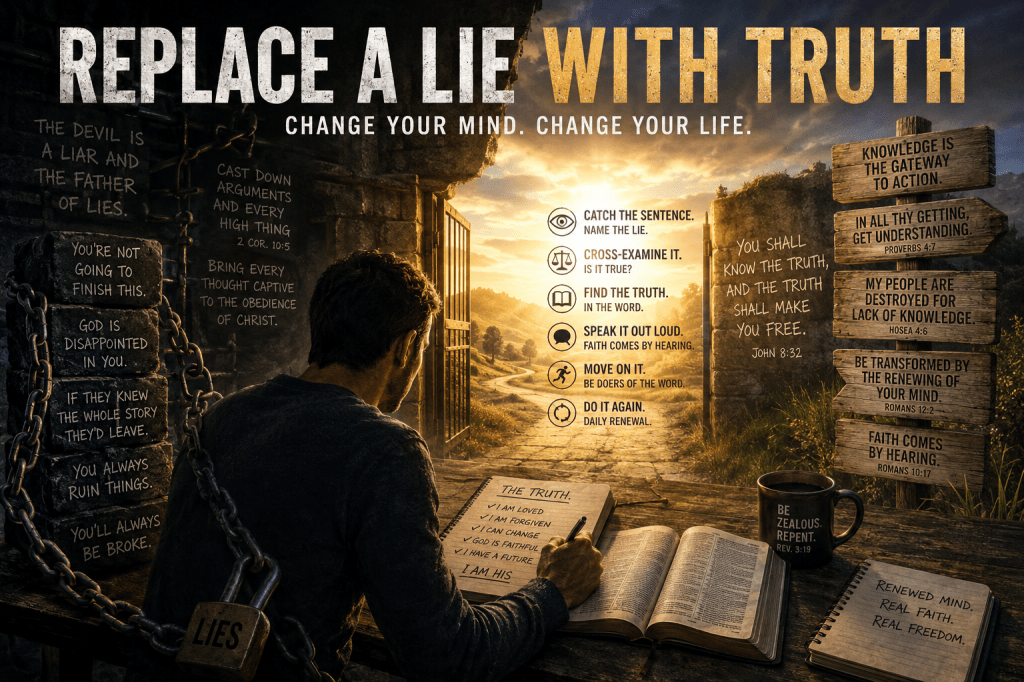
- I’m the kind of person who ruins things → so you leave first, and call it wisdom.
- God is disappointed in me specifically → so you stop asking Him for anything and call it humility.
- If they knew the whole story they’d leave → so nobody gets close, and you call it being private.
- I’ll always be broke, it runs in the family → so you never build anything, and call it being realistic.
Those aren’t moods. Every one of them is a doctrine with a work ethic. You’re holding a firm theological position about God, yourself and your future, and you’ve never checked the footnotes — and then you’re out there faithfully doing what it tells you to do.
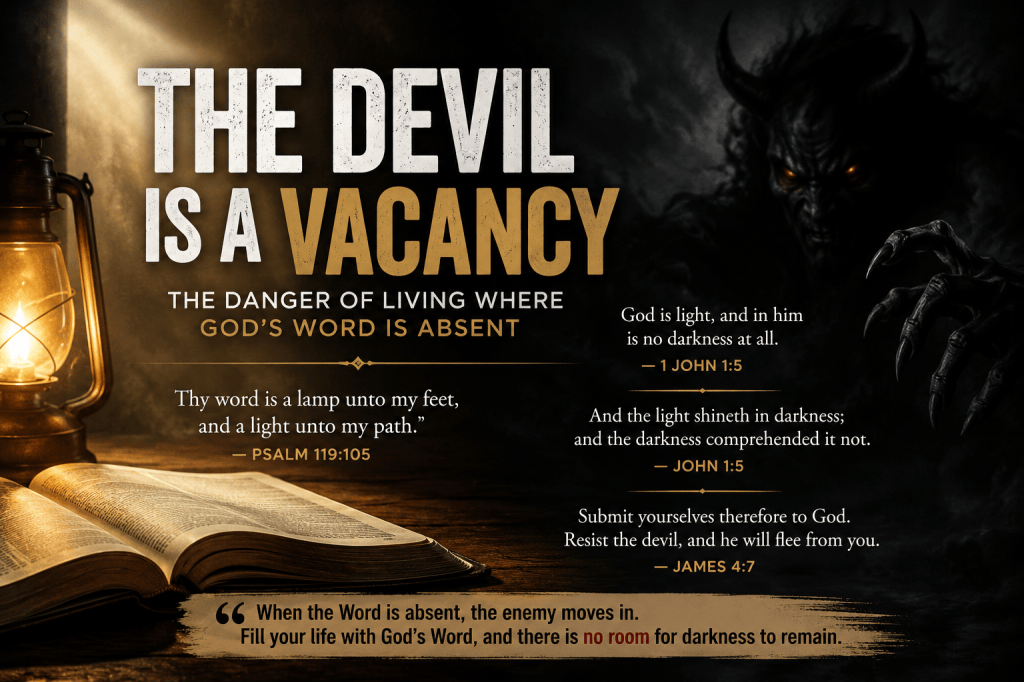
Jesus said the devil is a liar and the father of lies, and that when he lies he’s speaking his native language. Sit with that. Lying isn’t one item on his menu. It’s the entire inventory. He can’t make you do anything. He gets you to believe something false and then, honestly, we handle the rest ourselves. He barely has to stay for the second half.
Paul told the Corinthians to cast down arguments and every high thing that exalts itself against the knowledge of God, and to bring every thought captive to the obedience of Christ. Notice the word — arguments. These things build a case. They call witnesses. Most of us have been sitting in that courtroom for years letting the prosecution talk uninterrupted while the defense never showed up, and then acting on the verdict.
Repentance Is Not Feeling Bad, and I Was a Professional at Feeling Bad
So how do you get the gate open?
Most of us were handed a definition of repentance that goes: mess up, feel terrible, cry a reasonable amount, promise God you’ll do better, get on with your Tuesday.
I was excellent at that. Genuinely. If remorse were a spiritual gift I’d have been running conferences.
But that isn’t repentance. That’s regret in a church shirt.
The word in the Greek New Testament is metanoia — meta, change, and nous, the mind. Change of mind. A mind that thinks differently than the one that walked into the room. When John came out of the wilderness and when Jesus started preaching, that’s the word under repent, for the kingdom of heaven is at hand. Change your mind. The kingdom is right here — the way you currently think can’t see it.
Which explains why the feeling-bad model produces so little movement. You can feel awful about the behavior while leaving the belief that produced it completely undisturbed, sitting there, well-fed, waiting for you to calm down so it can get back to work. You cannot cry your way out of a belief. You have to replace it.
And Jesus wasn’t casual about the effort. To the church at Laodicea — the lukewarm one, convinced it was rich and needed nothing, which is a comfortable thing to be and a dangerous thing to stay — He said: As many as I love, I rebuke and chasten: be zealous therefore, and repent.
Be zealous. Not be weepy. Be zealous about changing your mind.
I’d been polite with my lies. That’s the honest word. A decades-long courteous negotiation with thoughts that were actively working against me, treating trespassers like difficult relatives. You can be lukewarm about a lot of things and survive. Be lukewarm about this one and you’ll be having the same argument with yourself in 2036, in a nicer house.
Positive Thinking Has No Authority
The world’s version of this is: swap the bad thought for a nicer one. Encourage yourself in the mirror. That holds for about four days.
Here’s why it fails. A nice thought has no authority. It’s an opinion competing with another opinion, and your pain has receipts. Your pain has dates and names and an excellent memory. “I am enough” is not winning that fight, because the other side isn’t fighting fair and never was.
Christian mind renewal is a different operation. We’re not upgrading a negative to a positive. We’re removing a lie and installing the truth — and truth here isn’t a concept you talk yourself into. Jesus said I am the way, the truth, and the life. He prayed sanctify them by Your truth; Your word is truth.
So replacing a lie with truth doesn’t mean saying something kind to yourself. It means going and finding the sentence God actually wrote and standing on that instead. Not because it’s more encouraging. Because it’s real, and the other one never was.
That’s the mechanism in you shall know the truth and the truth shall make you free. Knowing does the work. Freedom is the result. He didn’t say you shall feel the truth.
In All Thy Getting, Get Understanding
Which brings me to the part I ignored longest.
Solomon put it as a command with no exit clause: Wisdom is the principal thing; therefore get wisdom: and with all thy getting get understanding.
Look at the setup. With all thy getting. He assumes you’re out there getting things — money, property, a business, a title, a name. He’s not scolding you for it. Go get them. But somewhere in all that acquiring, pick up the one thing that decides what the rest is worth to you.
Because you can assemble an entire life and still get taken apart by something you simply didn’t know. God said it through Hosea and it isn’t a gentle line: My people are destroyed for lack of knowledge.
Not for lack of sincerity. Not for lack of showing up. For lack of knowledge. There are people who love God with everything they have getting quietly dismantled in one blind spot, and the whole operation would fold the second somebody turned a light on in that room. I’ve been that person — sincere, tithing, worshipping, and wrong about one thing, and paying for it in an area I hadn’t connected to it at all.
Knowledge Is a Spirit of the Lord
Here’s what reframed study for me completely.
When Isaiah described the Spirit that would rest on the Messiah, he listed it out: the Spirit of the LORD, the spirit of wisdom and understanding, the spirit of counsel and might, the spirit of knowledge and of the fear of the LORD.
Knowledge is named there as an operation of the Spirit of God.
So when something finally lands — when a verse you’ve read forty times suddenly opens — that’s not your brain having a better morning. That’s the Spirit of truth doing the exact job Jesus said He’d do: guiding us into all truth. Paul prayed the Ephesians would receive the spirit of wisdom and revelation in the knowledge of Him, that the eyes of their understanding would be enlightened.
Eyes of the understanding. There’s a set of eyes inside your mind and they can be shut, which explains the strange experience of reading a familiar verse and getting hit by it like a car. Nothing changed on the page. Somebody turned the lights on in the room.
This is also why I had to repent — actual metanoia — of the idea that studying is less spiritual than praying. Peter says add to your faith virtue, and to virtue knowledge. His last recorded instruction is grow in grace and in the knowledge of our Lord and Savior. Paul prays the Colossians would be filled with the knowledge of God’s will — and watch the reason he gives — that ye might walk worthy of the Lord. Knowledge, then walking. Gateway, then action. It’s the same order every time.
Nobody in the New Testament treats learning as the boring cousin of the real Christian life. That hierarchy is ours, and I suspect it survives because it’s easier to attend something than to read something.
Knowledge Is Cumulative, Which Is the Best News Here
This should make a slow week feel less pointless.
Every true thing you pick up attaches to every other true thing you already had, and the connections multiply faster than the facts do. You learn one doctrine and six passages you’d been politely nodding at for years snap into place. You learn one real thing about the character of God and a decade of confusing personal history reorganizes itself over a weekend.
That’s how a single right piece of information opens a pathway of thinking that flat-out did not exist in you the day before. Not a better mood — a new road, and now you can drive somewhere you literally could not have gone on Tuesday.
Which also means the study you did five years ago that felt like nothing at the time wasn’t wasted. It’s inventory. It’s sitting in you waiting on the one connecting piece that turns the pile into a highway. Proverbs says the heart of the prudent gets knowledge and the ear of the wise seeks it — both verbs. Wise people go looking. They don’t wait to be handed things.
Garner More Facts
You will not out-feel a lie. You out-evidence it.
Faith isn’t a mood you generate on a good Sunday. It’s settled conviction built on accumulated evidence about the character of God. That’s why so much of the Bible is records — genealogies, kings, cities, dates, eyewitness lists, testimony after testimony about real people whose names got written down. God didn’t send a book of encouraging sentiments. He sent a case file, on purpose.
So garner facts.
Read the Word until you can quote it — not to sound impressive in small group, but because you need something loaded and in reach at 2 a.m. when the accusation shows up, and 2 a.m. is not when you want to be flipping pages. Keep a written record of answered prayer with dates and specifics, because your memory will lie to you the moment pressure arrives, and it will lie confidently. Learn the doctrine well enough to explain it to somebody who disagrees. Find out why you believe what you believe before something makes you find out.
Every fact is a brick. You find out what you built with on a day you don’t get to schedule.
How to Actually Do This
Simple, not complicated, and daily — and daily is where it falls apart for everybody, me included.
1. Catch the sentence. Slow the thought down until you can write it in actual words. Vague dread is powerful. A sentence on paper is much less impressive, and it hates being written down.
2. Cross-examine it. Is this true? Where did I get it? Whose voice is it in — a parent’s, an ex’s, a bad year’s? Does it survive Scripture? Most die right here, purely because nobody ever asked them to prove anything.
3. Find the replacement in the Word. A verse, not a slogan. If the lie says God’s done with me, the replacement is Lamentations — His mercies are new every morning, great is His faithfulness. If it says I can’t change, it’s 2 Corinthians — if any man be in Christ, he is a new creature; old things are passed away, all things are become new.
4. Say it out loud. Yes, out loud, and yes, you’ll feel ridiculous. Faith comes by hearing, and the ear that needs it most is attached to your head.
5. Then move on it. This is the whole reason we did the first four. Truth you never act on is trivia. James says be doers of the word and not hearers only, deceiving yourselves — you can be deceived by a true thing if you never walk on it. The gate is open. Go through it.
6. Do it again tomorrow. Paul said be transformed by the renewing of your mind, and that’s a continuous tense. Not renewed once at a retreat in 2019 with good lighting. Renewed today. The mind isn’t a room you clean once, it’s a house you live in, and it gets dusty because you’re in there.
Go Slower, Then Go Further
The man who hastens with his feet misses the mark. So slow down long enough to find out what’s actually true — about God, about your situation, about yourself — and then move with everything you’ve got.
That’s not passivity. That’s the opposite. Most people never take real action; they just take fast action on bad information and call it faith.
Every lie you tear down and replace with truth is ground you don’t have to fight for twice, and a road you can now actually drive on. That’s freedom in the real sense. Not the absence of trouble — the absence of deception.
Metanoia. Change the mind, then change what you do, then get up tomorrow and do it again.
Take one lie today. One. Write it down, hold it against the Word, replace it — and don’t be polite about it.
Mark Sotomayor writes on faith, freedom, and the Spirit-filled life. Read more at marksotomayor.com.