“And he gave some, apostles; and some, prophets; and some, evangelists; and some, pastors and teachers; For the perfecting of the saints, for the work of the ministry, for the edifying of the body of Christ.” — Ephesians 4:11–12
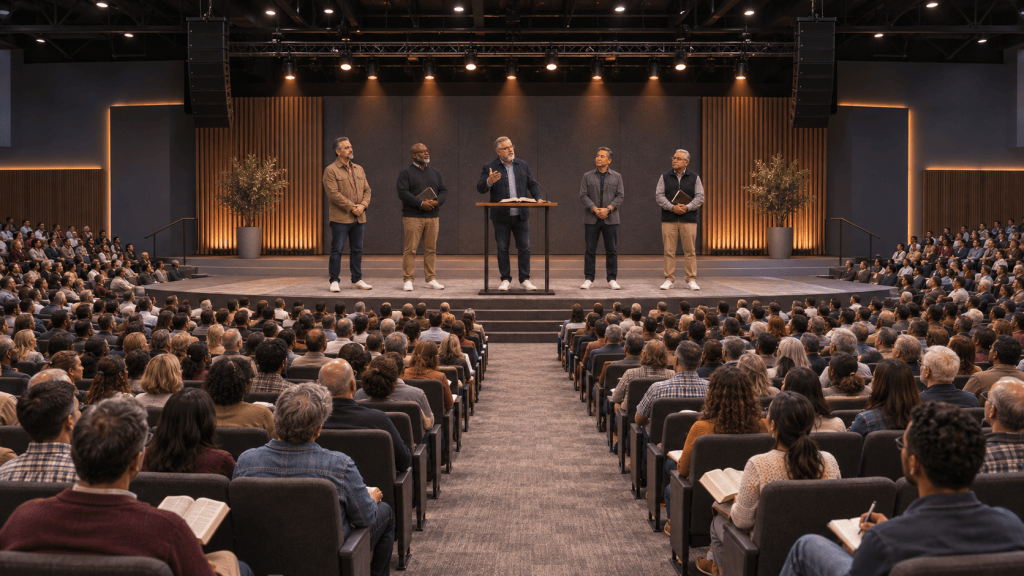
Walk into almost any church in America on a Sunday morning and you will find one office standing where five were given. There is a pastor. There may be a staff, a worship leader, a youth director, a board, and a building fund. But ask where the apostles are, where the prophets are, where the evangelists are, where the teachers are who stand alongside the shepherd as equals in the work, and you will be met with an awkward silence, a nervous laugh, or a confident explanation that those things “ended with the first century.”
I want to say plainly what I believe the Scriptures say plainly: a church that keeps one gift and shelves the other four has not improved on the Word of God. It has edited it. And editing what the Lord commanded is not a matter of style or denomination. It is disobedience.
What Christ Gave When He Ascended
Paul does not introduce the fivefold ministry as a suggestion or a passing remark. He sets it inside the ascension of Jesus Christ Himself: “Wherefore he saith, When he ascended up on high, he led captivity captive, and gave gifts unto men” (Ephesians 4:8). He is quoting David, who saw it a thousand years before: “Thou hast ascended on high, thou hast led captivity captive: thou hast received gifts for men; yea, for the rebellious also, that the LORD God might dwell among them” (Psalm 68:18).
Think about the weight of that. These offices are the spoils of the cross. Christ went down into death, broke its power, rose, ascended to the right hand of the Father, and from that throne He handed down gifts. Not ideas. Not programs. People. “He gave some, apostles; and some, prophets; and some, evangelists; and some, pastors and teachers.” When a church decides it only needs one of those gifts, it is standing before the conquering King, looking at what He brought back from the battle, and handing four-fifths of it back.
Paul says the same thing to the Corinthians: “And God hath set some in the church, first apostles, secondarily prophets, thirdly teachers, after that miracles, then gifts of healings, helps, governments, diversities of tongues” (1 Corinthians 12:28). God set them. Man did not vote them in, and man has no authority to vote them out.
How Long Were They Meant to Last?
The most common answer to all of this is that apostles and prophets were for the founding of the church and then ceased. But Paul tells us exactly how long these gifts were given for, and he does not say “until the canon closes” or “until the first generation dies.” He says:
“Till we all come in the unity of the faith, and of the knowledge of the Son of God, unto a perfect man, unto the measure of the stature of the fulness of Christ: That we henceforth be no more children, tossed to and fro, and carried about with every wind of doctrine, by the sleight of men, and cunning craftiness, whereby they lie in wait to deceive” (Ephesians 4:13–14).
Look honestly at the church today. Are we all in the unity of the faith? There are tens of thousands of denominations. Have we all come to the measure of the stature of the fulness of Christ? Are believers no longer tossed to and fro by every wind of doctrine? Of course not. The very conditions Paul said the fivefold ministry was given to cure are everywhere around us. If the job is not finished, the workers have not been dismissed.
And the Lord does not take His gifts back. “For the gifts and calling of God are without repentance” (Romans 11:29). “Jesus Christ the same yesterday, and to day, and for ever” (Hebrews 13:8). Peter preached on Pentecost that the outpouring of the Spirit, prophecy included, was “unto you, and to your children, and to all that are afar off, even as many as the LORD our God shall call” (Acts 2:39). If the Lord is still calling, the promise is still standing.
More Than Twelve: The New Testament Pattern
Some will say there were only ever twelve apostles, so the office is closed. But the New Testament itself names apostles outside the twelve. Luke writes, “Which when the apostles, Barnabas and Paul, heard of…” (Acts 14:14). Paul greets “Andronicus and Junia… who are of note among the apostles” (Romans 16:7), which most readers through history took to name them as apostles. Writing with Silvanus and Timothy, he says they could have been burdensome “as the apostles of Christ” (1 Thessalonians 2:6). The Lord Jesus even commended the church at Ephesus because it had “tried them which say they are apostles, and are not, and hast found them liars” (Revelation 2:2). You do not need to test apostles if the office is empty.
The prophets were plain to see too. “Now there were in the church that was at Antioch certain prophets and teachers” (Acts 13:1). Agabus came down from Judaea and foretold a famine (Acts 11:27–28), and later the binding of Paul (Acts 21:10–11). “Judas and Silas, being prophets also themselves, exhorted the brethren with many words, and confirmed them” (Acts 15:32). Philip had “four daughters, virgins, which did prophesy” (Acts 21:9), and he himself is called “Philip the evangelist” (Acts 21:8). Paul told Timothy, a pastor over a local work, to “do the work of an evangelist, make full proof of thy ministry” (2 Timothy 4:5).
That was the church the Holy Ghost built: many gifts, many hands, one Head. Antioch was not run by a single man behind a pulpit. It was a company of prophets and teachers who “ministered to the Lord, and fasted,” and while they did, “the Holy Ghost said, Separate me Barnabas and Saul for the work whereunto I have called them” (Acts 13:2). Out of that one obedient church came the missionary journeys that carried the gospel across the Roman world.
Adding To and Taking From
The Lord has always guarded His Word from both directions. “Ye shall not add unto the word which I command you, neither shall ye diminish ought from it, that ye may keep the commandments of the LORD your God” (Deuteronomy 4:2). “Add thou not unto his words, lest he reprove thee, and thou be found a liar” (Proverbs 30:6). At the very close of the canon, the warning is repeated with the highest stakes: “And if any man shall take away from the words of the book of this prophecy, God shall take away his part out of the book of life” (Revelation 22:19).
We are quick to condemn anyone who adds to Scripture. But diminishing it is just as forbidden. When a church reads Ephesians 4:11 and quietly lives as though it said, “And he gave some, pastors,” it has diminished the Word. It may not have torn the page out of the Bible, but it has torn it out of practice, and practice is where obedience lives.
Jesus confronted exactly this in His day: “Making the word of God of none effect through your tradition, which ye have delivered: and many such like things do ye” (Mark 7:13). And again, “For laying aside the commandment of God, ye hold the tradition of men” (Mark 7:8). The single-pastor model is a tradition. It is a long-standing, well-meaning, deeply rooted tradition, but it is still a tradition, and it has laid aside what God set in the church.
Does Paul Really Speak for the Lord Here?
Some treat Paul’s instructions on church order as his personal opinions, fitted to his time. Paul anticipated that. “If any man think himself to be a prophet, or spiritual, let him acknowledge that the things that I write unto you are the commandments of the Lord” (1 Corinthians 14:37). Those are commandments of the Lord, not the musings of an apostle. To set them aside because we think we know better is to put ourselves above the man the Holy Ghost chose to write them, and above the Holy Ghost who moved him to write them. “All scripture is given by inspiration of God, and is profitable for doctrine, for reproof, for correction, for instruction in righteousness” (2 Timothy 3:16).
Paul even warned what happens when anyone, himself included, departs from what was delivered: “But though we, or an angel from heaven, preach any other gospel unto you than that which we have preached unto you, let him be accursed” (Galatians 1:8). If Paul would not allow himself to revise the message, no church board or seminary has the authority to revise the structure he received from the Lord.
Partial Obedience Is Still Disobedience
King Saul did most of what God told him. He went to battle. He won. He destroyed most of Amalek. But he kept the best of the sheep and spared the king, and he called it worship. Samuel’s answer still rings: “Behold, to obey is better than sacrifice, and to hearken than the fat of rams. For rebellion is as the sin of witchcraft, and stubbornness is as iniquity and idolatry” (1 Samuel 15:22–23).
Many churches are doing a great deal of good. They preach, they feed the poor, they baptize, they sing. But good works do not cover selective obedience. “And why call ye me, Lord, Lord, and do not the things which I say?” (Luke 6:46). “If ye love me, keep my commandments” (John 14:15). “But be ye doers of the word, and not hearers only, deceiving your own selves” (James 1:22).
When David first tried to bring the ark to Jerusalem, he did it with sincere joy and a brand new cart, the way the Philistines had done it. Uzzah died. Later David confessed why: “the LORD our God made a breach upon us, for that we sought him not after the due order” (1 Chronicles 15:13). Sincerity did not substitute for the pattern. God told Moses, “And look that thou make them after their pattern, which was shewed thee in the mount” (Exodus 25:40), and Hebrews repeats it for us (Hebrews 8:5). The church has a pattern too, and it was shown to us in Ephesians 4.
What We Lose Without the Five
When the fivefold ministry is missing, the body suffers in ways we have learned to call normal.
Without apostles, the church loses its pioneers and foundation-layers, the ones sent out to plant and to set things in order (1 Corinthians 3:10; Titus 1:5). The church is “built upon the foundation of the apostles and prophets, Jesus Christ himself being the chief corner stone” (Ephesians 2:20).
Without prophets, the church loses its ear for what the Spirit is saying now. “Surely the Lord GOD will do nothing, but he revealeth his secret unto his servants the prophets” (Amos 3:7). “Where there is no vision, the people perish” (Proverbs 29:18). Paul commanded, “Quench not the Spirit. Despise not prophesyings. Prove all things; hold fast that which is good” (1 Thessalonians 5:19–21).
Without evangelists, the church turns inward and the harvest rots in the field. “How shall they hear without a preacher? And how shall they preach, except they be sent?” (Romans 10:14–15). “The harvest truly is plenteous, but the labourers are few” (Matthew 9:37).
Without pastors released to shepherd, rather than forced to be all five at once, the flock goes unfed and the shepherd burns out. “And I will give you pastors according to mine heart, which shall feed you with knowledge and understanding” (Jeremiah 3:15).
Without teachers, the saints never grow past milk. “For when for the time ye ought to be teachers, ye have need that one teach you again which be the first principles of the oracles of God” (Hebrews 5:12).
And here is the hidden cost: we have placed on one man the weight Christ divided among five. Jethro saw the same mistake in Moses: “Thou wilt surely wear away, both thou, and this people that is with thee: for this thing is too heavy for thee; thou art not able to perform it thyself alone” (Exodus 18:18). How many burned-out pastors, collapsed ministries, and moral failures trace back to a man trying to carry an office God never meant him to carry alone?
The Body Cannot Say “I Have No Need of Thee”
“And the eye cannot say unto the hand, I have no need of thee: nor again the head to the feet, I have no need of you” (1 Corinthians 12:21). Yet that is exactly what a church says when it builds its whole structure around one gift. The prophet is told he is too strange. The apostle is told he is presumptuous. The evangelist is told to go start his own ministry. The teacher is told to keep it to Sunday school. And the body limps along on one limb, wondering why it cannot run.
Paul’s vision is so much richer: “From whom the whole body fitly joined together and compacted by that which every joint supplieth, according to the effectual working in the measure of every part, maketh increase of the body unto the edifying of itself in love” (Ephesians 4:16). Every joint supplies. Every part works. That is how the body grows.
Testing, Not Throwing Out
I am not saying everyone who calls himself an apostle or prophet is one. The Scriptures warn of false prophets (Matthew 7:15; 1 John 4:1) and false apostles (2 Corinthians 11:13). But the answer to counterfeit money has never been to stop using money. The answer is to know the real thing. “Ye shall know them by their fruits” (Matthew 7:16). “Let the prophets speak two or three, and let the other judge” (1 Corinthians 14:29). “Let all things be done decently and in order” (1 Corinthians 14:40). God gave us the gifts and the guardrails together. Rejecting both because some have abused one is still rejecting what God gave.
Returning to the Pattern
So what do we do? We repent, and we return. Not to a man-made hierarchy where a few people get fancy titles, but to the humble, Spirit-led order of the New Testament, where Christ is the Head and every gift He gave is welcomed and released.
- Pray for laborers. “Pray ye therefore the Lord of the harvest, that he will send forth labourers into his harvest” (Matthew 9:38).
- Recognize who God has already placed among you. Many of these gifts are sitting in the pews right now, unrecognized and unused (1 Peter 4:10).
- Make room for the Spirit to speak. Antioch heard the Holy Ghost because they ministered to the Lord and fasted (Acts 13:2).
- Share the load. Let the pastor be a pastor, and let the others carry what God gave them to carry (Exodus 18:21–22).
- Test everything by the Word and by fruit. Hold fast what is good (1 Thessalonians 5:21).
“Except the LORD build the house, they labour in vain that build it” (Psalm 127:1). Jesus said, “I will build my church” (Matthew 16:18), and He told us how He would build it: with apostles, prophets, evangelists, pastors, and teachers, until we all come to the fulness of Christ. We do not know better than the Builder. Let us stop editing His blueprint and start obeying it.
“He that hath an ear, let him hear what the Spirit saith unto the churches” (Revelation 2:7).