2 Timothy 3:5, the Seven Woes, and the Ancient Priesthood of Dead Religion
There is a warning in Scripture so severe that most pulpits will not touch it. Not because it’s obscure.
Because it’s aimed at them.
Paul, chained in a Roman dungeon, writing his last letter before the executioner’s sword, tells Timothy what the last days will look like. And the terrifying thing about his list — lovers of self, lovers of money, boastful, proud, unholy, lovers of pleasure more than lovers of God — is where these people are found.
Not in the brothels.
Not in the pagan temples. In the church.
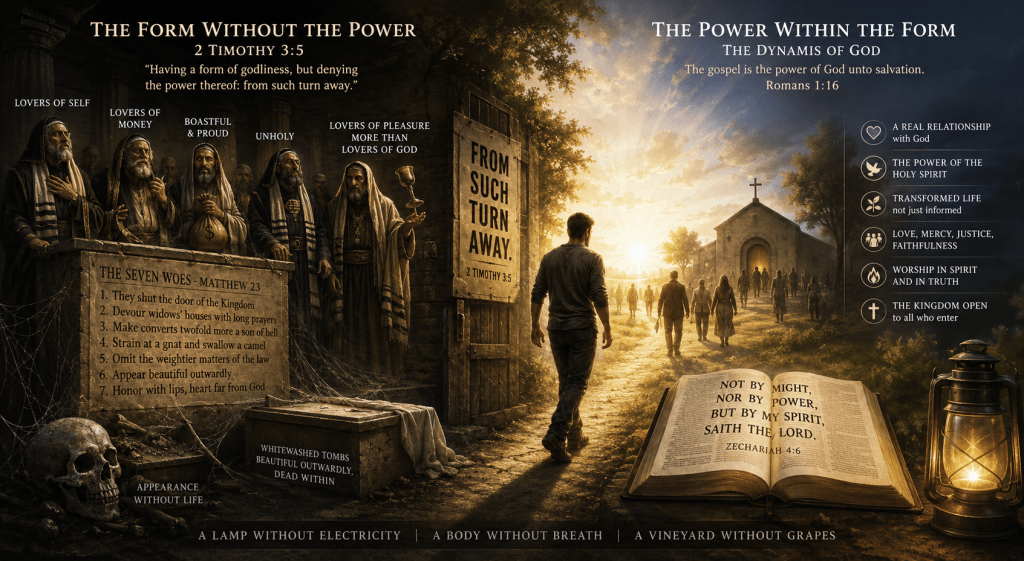
“Having a form of godliness, but denying the power thereof: from such turn away.” — 2 Timothy 3:5 (KJV)
The Mannequin and the Man
The Greek exposes everything.
Morphōsin (μόρφωσιν) — the form. The outward shape. The outline. The embodiment without the substance. A mannequin has the morphē of a man. It has arms, a face, posture. What it does not have is breath.
Eusebeia (εὐσέβεια) — godliness. Real reverence. Practical devotion. A life actually bent toward God. Paul is not attacking godliness. He is attacking its costume.
Ērnēmenoi (ἠρνημένοι) — denying. Not “unaware of.” Not “confused about.” This is active refusal. Disowning. Renouncing. The same root Peter used when he denied the Lord three times.
Dynamis (δύναμις) — the power. The word behind “dynamite.” God’s active, miraculous, transforming force. The gospel is the dynamis of God unto salvation (Romans 1:16). Jesus
returned from the wilderness in the dynamis of the Spirit (Luke 4:14). “Ye shall receive dynamis, after that the Holy Ghost is come upon you” (Acts 1:8).
So here is the picture Paul paints:
A people who keep the shell and renounce the life.
A lamp with no electricity.
A body with no breath.
A vineyard with no grapes.
And Paul’s command is not “reform them.” It is not “debate them.” It is “from such turn away.” Because dead religion is contagious, and it kills quietly.
Jesus Said It First — And He Said It Harder
Paul’s warning is not new doctrine. It is the echo of the most blistering sermon Jesus ever preached: Matthew 23, the seven woes against the scribes and Pharisees. If 2 Timothy 3:5 is the diagnosis, Matthew 23 is the autopsy.
Walk through it slowly. Every woe is a photograph of the form without the fire.
Woe #1: They shut the door they claim to guard
“But woe unto you, scribes and Pharisees, hypocrites! for ye shut up the kingdom of heaven against men: for ye neither go in yourselves, neither suffer ye them that are entering to go in.” — Matthew 23:13
Read that again. They lead others away from heaven, and they themselves don’t get in. These are the religious professionals. The Bible experts. The men with the robes and the titles. And Jesus says they are standing in the doorway of the Kingdom — not entering, and body-blocking everyone else.
That is the ultimate function of powerless religion: it doesn’t just fail to save. It prevents salvation. It inoculates people with just enough dead Christianity that they never catch the real thing.
Woe #2: A show of prayer while devouring the vulnerable
“Woe unto you, scribes and Pharisees, hypocrites! for ye devour widows’ houses, and for a pretence make long prayer: therefore ye shall receive the greater damnation.” — Matthew 23:14
“For a pretence make long prayer.” The prayer is theater. The eloquence is a costume.
And underneath the performance, they are financially consuming the most defenseless people in Israel — widows. Jesus says the length and beauty of the prayer doesn’t reduce the judgment. It increases it. “Greater damnation.”
Compare Matthew 6:5 — “they love to pray standing in the synagogues and in the corners of the streets, that they may be seen of men… They have their reward.” The applause is the payment. There is nothing left in heaven’s account.
Woe #3: Evangelism that manufactures sons of hell
“Woe unto you, scribes and Pharisees, hypocrites! for ye compass sea and land to make one proselyte, and when he is made, ye make him twofold more the child of hell than yourselves.” — Matthew 23:15
Sit with the horror of this verse. These men are missionaries. They are zealous. They cross oceans. They sacrifice. And the product of all that effort is a convert twice as much a son of hell as his teachers.
Why twice? Because the convert gets the system without ever having seen even the shadow of the real thing. He inherits the pride, the legalism, the hypocrisy — concentrated, purified, and defended with a convert’s zeal. Dead religion doesn’t just fail to reproduce life. It reproduces death, and each generation of it is deader than the last.
Evangelism without dynamis is multiplication of the mannequin.
Woe #4 and #5: Straining gnats, swallowing camels
“Ye blind guides, which strain at a gnat, and swallow a camel.” — Matthew 23:24
They tithed their kitchen herbs — mint, anise, cummin — down to the leaf, and omitted “the weightier matters of the law, judgment, mercy, and faith” (23:23). Both the gnat and the camel were unclean animals under the Law. They meticulously filtered out the smallest one and gulped down the largest one whole.
This is the signature of form-religion: obsessive precision about the trivial, total blindness about the essential. Ferocious about music styles, dress codes, and denominational trivia. Silent about pride, greed, unforgiveness, and the absence of the Holy Ghost.
Woe #6 and #7: Clean cups, whitewashed tombs
“Woe unto you, scribes and Pharisees, hypocrites! for ye are like unto whited sepulchres, which indeed appear beautiful outward, but are within full of dead men’s bones, and of all uncleanness.” — Matthew 23:27
A whitewashed tomb is the morphōsis of 2 Timothy 3:5. Beautiful outline. Fresh paint. Corpse inside. Jesus had already quoted Isaiah over these men: “This people draweth nigh unto me with their mouth, and honoureth me with their lips; but their heart is far from me” (Matthew 15:8, quoting Isaiah 29:13).
Lips near. Heart far. Form present. Power denied.
“Call No Man Father”
In the same sermon, Jesus dismantles the machinery that keeps the guild running — religious titles:
“But be not ye called Rabbi: for one is your Master, even Christ; and all ye are brethren. And call no man your father upon the earth: for one is your Father, which is in heaven.” — Matthew 23:8–9
Why does this matter so much? Because titles are how the form perpetuates itself without the power. When men become “Father,” “Rabbi,” “Master” — spiritual authority becomes an office you hold instead of an anointing you carry. The title replaces the dynamis. The robe replaces the mantle. And the flock learns to submit to a position rather than discern the Spirit.
Jesus is not banning respect. He is banning the professionalization of access to God — the priestly caste system that says you need a man in vestments between you and your Father.
The Light That Is Darkness
Here is the verse that should make every churchgoer tremble:
“Take heed therefore that the light which is in thee be not darkness.” — Luke 11:35
“If therefore the light that is in thee be darkness, how great is that darkness!” — Matthew 6:23
Notice: this is not addressed to people in darkness. It is addressed to people who are sure they have light. Woe to you if the light you think you have is actually darkness — because then there is no correction available. A man who knows he’s blind will grab a guide. A blind man convinced he sees perfectly will walk off the cliff and lead a congregation off it with him.
That is Jesus’ exact phrase for the Pharisees: “blind leaders of the blind. And if the blind lead the blind, both shall fall into the ditch” (Matthew 15:14).
Darkness that calls itself light is the most incurable condition in Scripture. It is why Jesus
told the Pharisees, “If ye were blind, ye should have no sin: but now ye say, We see; therefore your sin remaineth” (John 9:41).
The Guild Is Ancient: It Began with the Levites
Here is what almost nobody preaches. This corruption did not begin with the Pharisees. The Pharisees were merely the latest franchise of a guild that had been rotting for over a thousand years — the Levitical priesthood itself.
Understand: God ordained the Levites. The office was genuine. The pattern was heaven’s. But watch how quickly the form detached from the fire:
Aaron and the golden calf (Exodus 32). The first high priest of Israel — while Moses was still on the mountain — built an idol, and then declared, “Tomorrow is a feast to the LORD” (Exodus 32:5). Read that carefully. He gave the idolatry a worship service. He put the Lord’s name on the calf. Religion co-opting the sacred vocabulary for a dead thing — at the very birth of the priesthood.
Nadab and Abihu (Leviticus 10). Aaron’s own sons, ordained priests, offered “strange fire before the LORD, which he commanded them not” — and fire from the LORD devoured them. Strange fire is the perfect emblem: it looks like the real ministry. Same censers. Same incense. Same altar. Wrong source. God’s response established the principle forever: He would rather have no fire than false fire.
Eli’s sons, Hophni and Phinehas (1 Samuel 2). Priests of the house of the LORD who stole the sacrificial meat and slept with the women who served at the tabernacle door. Scripture’s verdict: “the sons of Eli were sons of Belial; they knew not the LORD” (1 Samuel 2:12). Full- time ministers. Daily handlers of holy things. And they did not know the God whose sacrifices they administered. Form of godliness in its purest ancient strain.
The priest and the Levite on the Jericho road (Luke 10:31–32). When Jesus wanted to portray religion that sees a dying man and crosses to the other side, He didn’t pick a tax collector or a Roman. He picked a priest and a Levite — likely hurrying to or from temple duty, too ceremonially concerned to touch bleeding flesh. The despised Samaritan carried the mercy the ordained men denied.
Malachi’s indictment (Malachi 1–2). God’s last recorded words to Old Testament Israel are aimed almost entirely at the priests: “O priests, that despise my name… ye offer polluted bread upon mine altar” (Malachi 1:6–7). And then this devastating line: “My covenant was with him [Levi] of life and peace… but ye are departed out of the way; ye have caused many to stumble at the law; ye have corrupted the covenant of Levi” (Malachi 2:5, 8). The covenant was real. The corruption was total. And God says He would rather someone “shut the doors” of the temple than continue the empty performance (Malachi 1:10).
Hosea’s summary (Hosea 4:6). “My people are destroyed for lack of knowledge: because thou hast rejected knowledge, I will also reject thee, that thou shalt be no priest to me.” The people perish, and the priesthood is the reason.
So by the time the scribes and Pharisees stand before Jesus, they are not innovators. They are heirs. The guild of blind guides — men who handle the holy professionally while denying its power personally — runs in an unbroken line from the golden calf, through strange fire, through Hophni and Phinehas, through the polluted altars of Malachi, straight into the whitewashed tombs of Matthew 23. And Paul, in 2 Timothy 3, tells us the same guild will be fully staffed in the last days — wearing not linen ephods this time, but the vocabulary and structures of Christianity itself.
Same guild. New uniforms.
“What Fruit Is Therefore Picked Up?”
Jesus gave us the test, and it is not doctrine, volume, size, or sincerity:
“Ye shall know them by their fruits. Do men gather grapes of thorns, or figs of thistles?… A good tree cannot bring forth evil fruit, neither can a corrupt tree bring forth good fruit.” — Matthew 7:16–18
So what fruit does the form-without-power tree actually produce? Scripture itemizes the harvest:
Sons of hell, doubled (Matthew 23:15). Its converts are worse off than before. Devoured widows (Matthew 23:14). The weak are consumed, not protected.
Shut doors (Matthew 23:13). Seekers are blocked from the Kingdom by the very people advertising it.
Stumbling blocks (Malachi 2:8). “Ye have caused many to stumble.”
A destroyed people (Hosea 4:6). Congregations perishing for lack of true knowledge while drowning in religious activity.
Dead men’s bones (Matthew 23:27). Inward corruption under outward beauty.
Hatred from heaven for its own worship services (Isaiah 1:13–15; Amos 5:21 — “I hate, I despise your feast days”). God refusing the very sacrifices His own Law prescribed, because the heart behind them is dead.
“I never knew you” (Matthew 7:22–23). The final fruit. Men who prophesied, cast out devils, and did many wonderful works “in thy name” — hearing the Judge say He never knew them. They had ministry. They had activity. They had results. They did not have relationship.
“Ye shall know them by their fruits” is the verse immediately before this passage — that is not an accident.
Contrast the fruit of the dynamis:
“But the fruit of the Spirit is love, joy, peace, longsuffering, gentleness, goodness, faith, meekness, temperance.” — Galatians 5:22–23
That is the whole test. Not the size of the building. Not the beauty of the liturgy. Not the length of the prayers — Jesus specifically warned about long prayers. The fruit. Are people being transformed, or just recruited? Repenting, or just attending? Set free, or just sedated?
A tree is not judged by its bark. It is judged at harvest.
Sardis, Laodicea, and Us
The risen Christ says to the church at Sardis: “Thou hast a name that thou livest, and art dead” (Revelation 3:1). A reputation of life. That is morphōsis in four words.
To Laodicea: “Thou sayest, I am rich… and knowest not that thou art wretched, and miserable, and poor, and blind, and naked” (Revelation 3:17). The light they thought they had was darkness — and they didn’t know.
And Paul’s parallel verdict in Titus 1:16: “They profess that they know God; but in works they deny him.” Profession in the mouth, denial in the life. The exact anatomy of 2 Timothy 3:5.
Even Timothy is warned that these people are “ever learning, and never able to come to the knowledge of the truth” (2 Timothy 3:7) — two verses after our text. Endless Bible studies. Endless conferences. Endless content. Zero transformation. Learning itself becomes the substitute for obedience.
The Way Out Is Not Better Religion
Here is where this must land, because tearing down the whitewash is worthless if we don’t point to the life.
Jesus did not come to renovate the tomb. He came to raise the dead man inside it.
The answer to the form is not a better form. It is the power — the same dynamis Paul refused to trade away: “My speech and my preaching was not with enticing words of man’s wisdom, but in demonstration of the Spirit and of power: that your faith should not stand in the wisdom of men, but in the power of God” (1 Corinthians 2:4–5). “For the kingdom of God is not in word, but in power” (1 Corinthians 4:20).
The Pharisees searched the Scriptures and missed the Author standing in front of them:
“Search the scriptures; for in them ye think ye have eternal life… And ye will not come to me, that ye might have life” (John 5:39–40). Knowledge of the Book without surrender to its Lord is just a heavier gnat-strainer.
So examine the tree. Yours first — “Examine yourselves, whether ye be in the faith” (2 Corinthians 13:5). Is there fruit only the Holy Ghost can grow? Repentance. Holiness. Love for enemies. Power over sin. Hunger for God Himself and not merely for religious activity about Him.
If the answer is a shell — beautiful, respectable, hollow — then hear the mercy hidden inside the hardest verse in this whole study. Jesus finished His seven woes not with a curse, but with a cry:
“O Jerusalem, Jerusalem… how often would I have gathered thy children together, even as a hen gathereth her chickens under her wings, and ye would not!” — Matthew 23:37
He still wants to gather. The fire is still offered. The dynamis is still promised “to as many as the Lord our God shall call” (Acts 2:39).
Keep the form if you must. But for God’s sake — literally — get the fire back inside it. And from everything that refuses the fire while wearing the costume?
From such turn away.