There is no such thing as cold. Ask any physicist. Cold is not a substance that pours into a room and displaces the warmth; there is only heat, and the measure of its absence. Turn the furnace off and nothing arrives. Something leaves. And what remains after the leaving, we give a name to, and we speak of it as though it were a thing in itself. We say the cold got in. It did not. The heat got out.
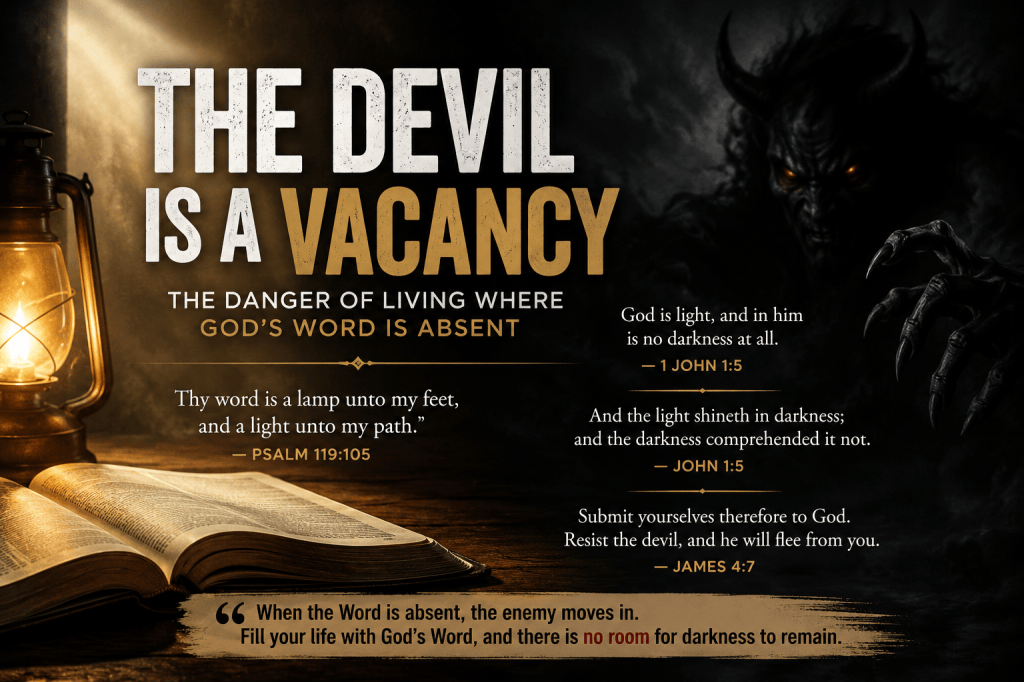
Darkness works the same way. No one has ever built a lamp that emits darkness. Darkness is not poured; light is withdrawn, and the room is left with what it had all along underneath. “God is light, and in him is no darkness at all” (1 John 1:5). Not a little darkness balanced against a great deal of light. None at all. And when the light came into the world, John does not describe a war of equals: “And the light shineth in darkness; and the darkness comprehended it not” (John 1:5). The darkness did not fight the light. It could not even grasp it.
I want to propose something that may sound strange on first hearing, though I believe the Scripture bears it out from Genesis to Revelation. The devil is not a rival god. He is not the black square set opposite God’s white square on some cosmic chessboard, two equal powers pushing against each other while creation waits to see who wins. He is a vacancy. He is the name we give to what is left standing where God is not.
God Is His Word
And here the matter becomes intensely practical, because God is not an abstraction and He is not far off. He has told us plainly what He is.
“In the beginning was the Word, and the Word was with God, and the Word was God.” (John 1:1)
That is not poetry laid over a doctrine. That is an identity statement. And it is not an isolated one. When John saw Him coming out of heaven on a white horse, with the armies of heaven following, he did not say His name was called Powerful, or Mighty, or Terrible in Judgment. He said, “and his name is called The Word of God” (Revelation 19:13). David went further than most of us are comfortable going: “thou hast magnified thy word above all thy name” (Psalm 138:2). And when the fullness of God took on a body and walked the roads of Galilee, the description was the same: “And the Word was made flesh, and dwelt among us” (John 1:14).
So follow the line all the way down. If God is His Word, then a lack of God is a lack of His Word. And a lack of His Word is a lack of His direction — because directing is what the Word does. It is not decoration. It is not comfort literature. It is a light held out over the next step of a path you cannot see the end of.
“Thy word is a lamp unto my feet, and a light unto my path.” (Psalm 119:105)
“For the commandment is a lamp; and the law is light; and reproofs of instruction are the way of life.” (Proverbs 6:23)
A lamp unto the feet. Not a floodlight over the whole county. Enough for the next stride, and then the next one, which means the Word is not something you consulted once at conversion and filed away. It is something you walk by, continuously, or you walk in the dark. And walking in the dark is not a neutral condition. It is the entire territory of the enemy.
The Void Before the Voice
Go back to the first page and watch the order of events, because the order is the whole argument.
“And the earth was without form, and void; and darkness was upon the face of the deep. And the Spirit of God moved upon the face of the waters.” (Genesis 1:2)
Before there is any serpent, before there is any rebellion, before there is any adversary named anywhere in the text, there is emptiness. Without form. Void. Dark. And notice what God does not do. He does not fight it. He does not wrestle it. There is no battle scene, no clash of armies, no strain.
“And God said, Let there be light: and there was light.” (Genesis 1:3)
He spoke, and the vacancy ended. That is the whole method. “By the word of the LORD were the heavens made; and all the host of them by the breath of his mouth” (Psalm 33:6). “Through faith we understand that the worlds were framed by the word of God, so that things which are seen were not made of things which do appear” (Hebrews 11:3). The Word is what fills emptiness. It is the only thing that ever has.
And Jeremiah, watching judgment fall on a nation that had abandoned that Word, reached back for the only language that would describe it: “I beheld the earth, and, lo, it was without form, and void; and the heavens, and they had no light” (Jeremiah 4:23). Withdraw the Word and the creation does not become evil. It becomes empty again. It reverts.
The Serpent Brought No New Material
Now watch the tempter work, and watch closely, because he has never changed his method and he has never needed to.
“Now the serpent was more subtil than any beast of the field which the LORD God had made. And he said unto the woman, Yea, hath God said, Ye shall not eat of every tree of the garden?” (Genesis 3:1)
He did not build anything. He did not create an alternative world, or a competing law, or a rival scripture. He asked a question about a word. And what God had actually said was generous almost to the point of extravagance: “Of every tree of the garden thou mayest freely eat” (Genesis 2:16). One restriction in a paradise of permissions. The serpent’s opening move was to take that word and shrink it, to make the fence look like the field.
And look at Eve’s answer, because the erosion had already begun before he finished. She replies that God said they must not eat of it, “neither shall ye touch it” (Genesis 3:3). God never said that. The Word had already gone slack in her mouth. She was holding a paraphrase, and a paraphrase will not hold weight.
Then comes the last move, which is pure subtraction — a single negation dropped into what God had actually declared: “Ye shall not surely die” (Genesis 3:4). Take God’s sentence, insert a not, and hand it back. That is the whole arsenal. There was no second creation on offer in the garden. There was only the first one, with a word removed.
Jesus described the same emptiness in the same being, and He used the language of privation to do it:
“He was a murderer from the beginning, and abode not in the truth, because there is no truth in him. When he speaketh a lie, he speaketh of his own: for he is a liar, and the father of it.” (John 8:44)
No truth in him. Not “he opposes the truth from a fortress of his own truth.” There is nothing inside. Ezekiel says of him, “Thou wast perfect in thy ways from the day that thou wast created, till iniquity was found in thee” (Ezekiel 28:15) — which is the record of a departure, a going-out, a former fullness that drained. He is a hollowed thing. And a hollowed thing can only hollow.
The House That Was Swept and Empty
If you want the doctrine stated by Christ Himself in a single parable, here it is, and it may be the most under-preached warning in the Gospels.
“When the unclean spirit is gone out of a man, he walketh through dry places, seeking rest, and findeth none. Then he saith, I will return into my house from whence I came out; and when he is come, he findeth it empty, swept, and garnished. Then goeth he, and taketh with himself seven other spirits more wicked than himself, and they enter in and dwell there: and the last state of that man is worse than the first.” (Matthew 12:43–45)
Read what the house actually was. Swept. Garnished. Clean. Tidy. Decorated, even. Nobody could walk past and find fault with it. The problem was not filth. The problem was the first word in that list — empty. Something had been evicted, and nothing had moved in behind it.
This is why moral reformation alone is such a fragile business, and why so many people who genuinely cleaned up their lives find themselves seven times worse two years later and cannot understand what happened. They emptied the house. They never filled it. And emptiness is not neutral ground; emptiness is an advertisement. A vacancy is a posted invitation, and it will be answered.
Paul put it in real-estate terms and did not soften it:
“Neither give place to the devil.” (Ephesians 4:27)
Place. Room. Ground. Square footage. He cannot seize what he is not given, and what he is given is always space — the unlit corner, the un-surrendered decision, the area of your life over which you have never once asked, and never once heard, what God has to say about it.
A Famine of Hearing
Scripture diagnoses whole nations this way, and it never diagnoses them by the strength of their enemies. It diagnoses them by what they were missing.
“Behold, the days come, saith the Lord GOD, that I will send a famine in the land, not a famine of bread, nor a thirst for water, but of hearing the words of the LORD.” (Amos 8:11)
“My people are destroyed for lack of knowledge.” (Hosea 4:6)
“Where there is no vision, the people perish: but he that keepeth the law, happy is he.” (Proverbs 29:18)
A famine is not an invasion. Nothing marches in. Something simply stops arriving, and everything downstream of it dies. In the days of the boy Samuel the historian records it as a scarcity, not an occupation: “the word of the LORD was precious in those days; there was no open vision” (1 Samuel 3:1).
And the book of Judges gives us the anatomy of a collapsing society in one verse containing two absences and one result:
“In those days there was no king in Israel: every man did that which was right in his own eyes.” (Judges 21:25)
No king — no governing voice. Therefore every man doing what was right in his own eyes. That is not a description of a people who chose evil over good. It is a description of a people with no direction, and so they supplied their own, and what they supplied filled seventeen chapters with horrors. Isaiah names the mechanism exactly: “To the law and to the testimony: if they speak not according to this word, it is because there is no light in them” (Isaiah 8:20). No light in them. The same privation, again.
Even our best-known confession of sin is worded as a failure of direction rather than an act of malice: “All we like sheep have gone astray; we have turned every one to his own way” (Isaiah 53:6). Astray is not a place. You cannot arrive there. Astray is what happens when you are not being led. And Jeremiah admits the reason we cannot self-correct our way out of it: “O LORD, I know that the way of man is not in himself: it is not in man that walketh to direct his steps” (Jeremiah 10:23).
Set that beside the shepherd Psalm and hear how deliberately David chose his words. “The LORD is my shepherd; I shall not want… he leadeth me in the paths of righteousness for his name’s sake” (Psalm 23:1–3). The presence of the Shepherd is described first as the abolition of want. Of lack. Of the empty place.
The Wilderness Answer
Then the Son of God went into the desert, and every temptation was aimed with precision at a gap.
Forty days without food, and the first assault is at the point of hunger. An unknown carpenter with no platform, and the second is at the point of obscurity. A kingdom promised but not yet given, and the third is at the point of poverty and delay. Emptiness, emptiness, emptiness — the enemy went looking for the hollow places, because hollow places are the only places he knows how to work.
And every answer had the identical shape. Not lightning. Not thunder. Three words and a quotation.
“It is written, Man shall not live by bread alone, but by every word that proceedeth out of the mouth of God.” (Matthew 4:4)
“It is written again” (Matthew 4:7). “Get thee hence, Satan: for it is written” (Matthew 4:10). Three temptations, three Scriptures, all of them out of Deuteronomy, all of them spoken by a starving man with nothing else in His hands. He did not destroy the tempter in the wilderness. He filled the empty room with the Word until there was no floor left to stand on, and “when the devil had ended all the temptation, he departed from him for a season” (Luke 4:13).
“Hath Nothing in Me”
And then, near the end, on the last night, Jesus says the sentence that I think settles the entire question.
“Hereafter I will not talk much with you: for the prince of this world cometh, and hath nothing in me.” (John 14:30)
He came. He searched. He found nothing.
Not “he found something small and was defeated.” Not “he found a weakness and was repelled.” He found no vacancy at all. There was no unlit room in that house, no unswept corner, no square foot of ground unclaimed by the Father’s word, nowhere to set down so much as a suggestion. “For in him dwelleth all the fulness of the Godhead bodily” (Colossians 2:9). Fullness. The exact opposite of the empty, swept, and garnished house. The devil met a man in whom there was no absence of God, and having no absence to occupy, he had no work to do.
That is your model. Not a fiercer fight. A fuller house.
Then How Do You Fight Nothing?
You do not fight nothing. You cannot punch a hole. You fill it. And notice that James, who gives us the most quoted verse on resisting the devil, puts a clause in front of it that we routinely amputate:
“Submit yourselves therefore to God. Resist the devil, and he will flee from you.” (James 4:7)
Submission comes first, and it is not decorative. Submission is the filling. Resistance is only what filling looks like from the enemy’s side of the door. A man trying to resist the devil without first submitting to God is a man trying to bail out a boat while refusing to plug the hole.
So what does the filling actually consist of? Scripture is not vague about it. Every single instrument named is the Word, or the Spirit who authored it.
“Thy word have I hid in mine heart, that I might not sin against thee.” (Psalm 119:11)
“Let the word of Christ dwell in you richly in all wisdom.” (Colossians 3:16)
“And be not drunk with wine, wherein is excess; but be filled with the Spirit.” (Ephesians 5:18)
Hidden in the heart. Dwelling richly. Filled. That is occupancy language, every phrase of it. And when Paul finally hands the believer a weapon in Ephesians 6, out of the entire armour there is exactly one thing you can swing, and it is not your willpower and it is not your reputation: “the sword of the Spirit, which is the word of God” (Ephesians 6:17). One offensive weapon in the kit. The same one Christ used in the desert. “For the word of God is quick, and powerful, and sharper than any twoedged sword” (Hebrews 4:12).
Paul even defines sin itself in the language of absence. “For whatsoever is not of faith is sin” (Romans 14:23) — and faith is not a mood, because “faith cometh by hearing, and hearing by the word of God” (Romans 10:17). Put the two together and you get this: sin is action taken where no word from God has been heard. It is not first an act of defiance. It is an act performed in the dark. And the universal verdict, “all have sinned, and come short of the glory of God” (Romans 3:23), is literally a verdict of falling short. Of lack. Of not reaching. Of a gap between where we are and where the light is.
Which means the cure is direction, continuously received, and God has promised precisely that:
“And thine ears shall hear a word behind thee, saying, This is the way, walk ye in it, when ye turn to the right hand, and when ye turn to the left.” (Isaiah 30:21)
“Trust in the LORD with all thine heart; and lean not unto thine own understanding. In all thy ways acknowledge him, and he shall direct thy paths.” (Proverbs 3:5–6)
“My sheep hear my voice, and I know them, and they follow me” (John 10:27). “The steps of a good man are ordered by the LORD” (Psalm 37:23). Hearing, then following. Ordered steps, not general principles. The remedy for a lack of direction is not more effort in the dark. It is the lamp.
One Necessary Caution
Let me be careful here, because a true thought pressed too far becomes a false one.
I am not arguing that the devil is imaginary, or merely a figure of speech, or a poetic name for our bad habits. The Scripture speaks of him as someone. He walks about “as a roaring lion, seeking whom he may devour” (1 Peter 5:8). He presents himself before God and speaks in Job 1. He accuses the brethren day and night (Revelation 12:10). Paul warns us not to be ignorant of his devices (2 Corinthians 2:11) and tells us plainly that “we wrestle not against flesh and blood, but against principalities, against powers” (Ephesians 6:12). Anyone who has done real spiritual work knows better than to treat that as metaphor.
The question is not whether he is. The question is what he is made of — and the answer is that he has no substance of his own. No creative power. No word to speak that originated with him. He is a borrower and a subtracter, and every work he has ever done has been done in ground somebody vacated. Of the idols men gave themselves to, Paul says flatly that “an idol is nothing in the world” (1 Corinthians 8:4), and Isaiah told them to their faces, “Behold, ye are of nothing, and your work of nought” (Isaiah 41:24). When the final lawless one is revealed, Paul does not describe a war. He describes an exhalation: “whom the Lord shall consume with the spirit of his mouth” (2 Thessalonians 2:8). The breath of God’s mouth. The same breath that made the heavens. It is not a duel. It is a lamp switched on in a room.
And it is already finished in principle. “Having spoiled principalities and powers, he made a shew of them openly, triumphing over them in it” (Colossians 2:15). “That through death he might destroy him that had the power of death, that is, the devil” (Hebrews 2:14). “For this purpose the Son of God was manifested, that he might destroy the works of the devil” (1 John 3:8).
What This Costs You on a Tuesday Morning
If this is true, then a great deal of what we call spiritual warfare has been aimed in the wrong direction, and a great deal of what we call ordinary life is spiritual warfare and we never noticed.
The question is not chiefly “what is the enemy doing to me today.” The question is: what has God said, and am I doing it? Because the vacancies are his entire territory. The decision you have never submitted. The relationship you have never asked about. The business you run on instinct and market wisdom and have never once brought to the Lord. The hour of the morning that used to belong to the Word and now belongs to a screen. None of those are dramatic. None of them feel like a battlefield. Every one of them is unlit floor space, swept and garnished and available.
You will not out-argue an absence. You will not out-discipline it. You fill it, one word at a time, the way it was done in the beginning — over the deep, in the dark, where nothing had form and nothing had light, and God did not fight the void.
He spoke to it.
“And God said, Let there be light: and there was light.” (Genesis 1:3)