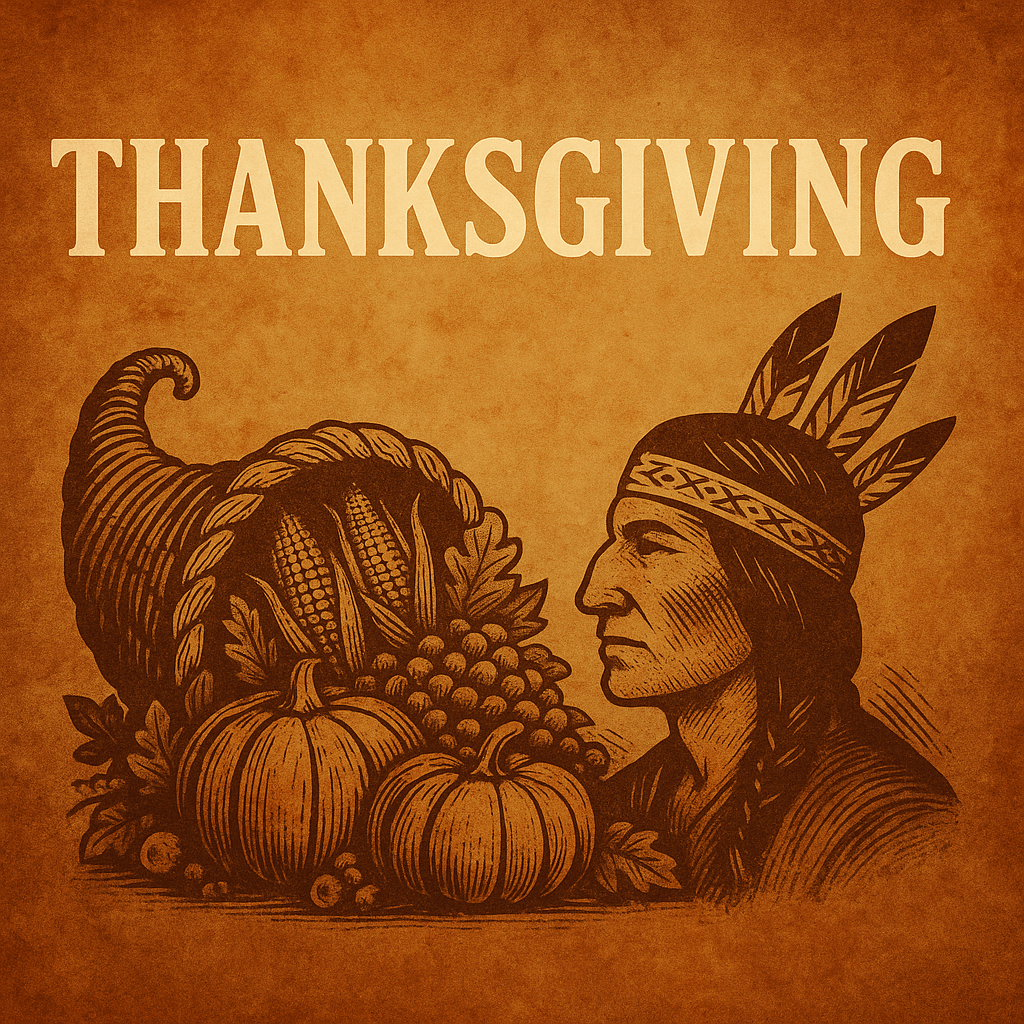
Every November, America steps into a familiar rhythm — the grocery carts fill up, the airports clog, the kitchen timers start their marathon, and families gather around tables that hold more food than most of the world sees in a week.
But beneath the decorations and traditions, Thanksgiving carries a history that deserves a clear-eyed look. Not cynical. Not romanticized. Just honest.
Because honesty, more than anything, is what this country has always needed.
Where Gratitude Actually Began
Long before 1621, long before the phrase “Pilgrims and Indians” was ever scribbled in a schoolbook, the Indigenous peoples of North America practiced seasonal thanksgiving rituals.
Across the continent:
Tribes held ceremonies for harvests, rainfall, hunting seasons, and the changing of the earth. Gratitude wasn’t an annual event — it was a rhythm of life. Giving thanks wasn’t something you scheduled; it was something you honored.
So when the English colonists arrived with their own faith traditions, they weren’t bringing the concept of gratitude to the New World — they were entering a land where gratitude already had ancient roots.
The Part We All Know… and the Parts Many Don’t
Yes, there was a three-day feast in 1621 between the Plymouth settlers and the Wampanoag Nation.
Yes, it was peaceful.
And yes, it was a meeting that mattered.
But that moment also existed in a much larger story — one that included pandemics, shifting power dynamics, uneasy alliances, and two civilizations trying to figure out whether they could trust each other.
It wasn’t a fairytale.
It wasn’t a tragedy.
It was human — complicated, fragile, hopeful, and tense.
And sometimes, the best way to honor history is to let it be what it was, instead of what we wish it had been.
Why We Still Celebrate Today
Our modern version of Thanksgiving came centuries later, when Abraham Lincoln — in the middle of a brutal civil war — declared a national day of gratitude.
He didn’t ask Americans to overlook their pain.
He asked them to find meaning inside it.
To pause.
To breathe.
To remember that gratitude does not require perfection — only perspective.
Thanksgiving today isn’t a reenactment.
It’s an invitation.
An Invitation to Maturity
Not the kind that comes with age, but the kind that comes with understanding:
That gratitude doesn’t erase the past — it illuminates the future. That acknowledging the darker chapters of history doesn’t make you unpatriotic — it makes you grounded. That honoring Native resilience isn’t “taking sides” — it’s respecting truth. That thankfulness and accountability can live in the same sentence.
A mature nation, like a mature person, can hold multiple truths at once.
The Table Means More When You Know the Story
This season, when the table fills up and the house smells like a Norman Rockwell painting come to life, remember this:
You’re sitting inside a tradition built by many cultures, shaped by hardship and hope, and carried forward not because it was perfect — but because it was meaningful.
Thanksgiving is a reminder that America’s story has always been bigger than a single moment, or a single people, or a single meal.
It is a story of survival, collision, cooperation, conflict, rebirth, and resilience.
And in a world that rarely slows down, maybe the smartest thing we can do — and the kindest — is to pause long enough to appreciate the ground we’re standing on, the people who came before us, and the new paths we’re carving today.

**Because gratitude is not a weakness.
And honesty is not a burden.
Together, they are the backbone of a country still learning, still striving, still becoming.**

 MARK SOTOMAYOR